

How Eclipse helps institutions certify their most important data, so the business trusts it, uses it, and can defend it to regulators, using the six-step Data Certification Lifecycle.
The challenge
Most institutions rely on a small set of critical data elements for regulatory reporting, risk models, and executive dashboards. Too often, ownership is unclear, definitions differ between teams, quality checks are scattered, and every regulatory question sets off a manual hunt for evidence. Business users build their own workarounds because they don’t trust the official data.
Our approach: the Data Certification Lifecycle
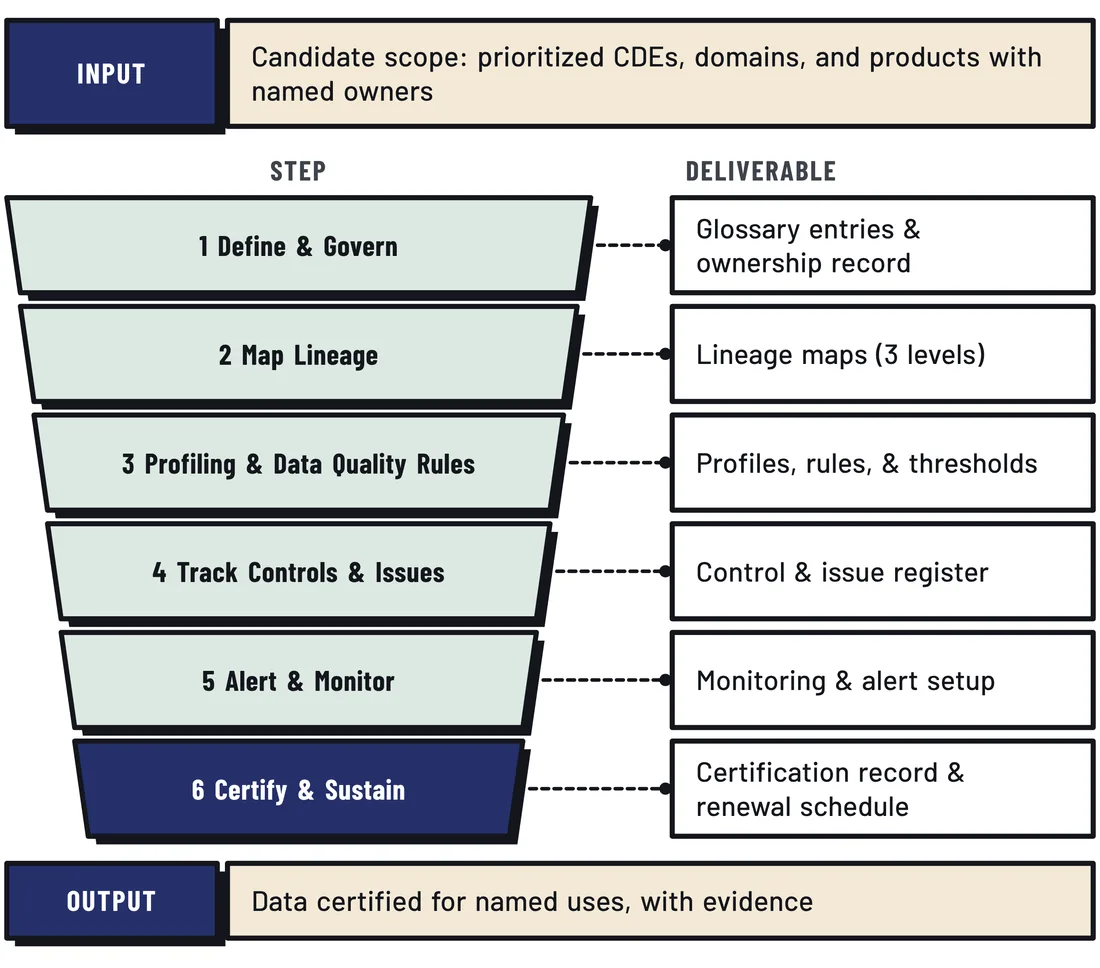
Certification is not a one-time project. It is a wheel that keeps turning, in six steps:
- Define and Govern. Agree what each data element means, who owns and stewards it, and which source is authoritative.
- Map Lineage. Trace how the data moves and changes, from source to report and to every downstream use.
- Profiling and Data Quality Rules. Profile the data for a factual baseline, agree business rules with the business, and implement them as technical rules with thresholds.
- Track Controls and Data Quality Issues. Document the controls that protect the data, along with open issues, remediation plans, and accepted limitations.
- Alert and Monitor. Run ongoing checks so change, degradation, or failure is caught early.
- Certify and Sustain. Build certification into the workflow, with approvals, evidence, recertification triggers, and business-as-usual ownership.
What our clients get
- A clear owner, steward, and agreed definition for every critical data element.
- Traceable lineage and documented controls that answer a regulator’s question with evidence, not a manual hunt.
- Data quality rules and monitoring that catch problems before they reach a report.
- A repeatable certification and recertification process that the business runs as part of its normal work.
Why it matters
Certified data gives the business a clear answer to “can I use this?”, gives regulators traceable evidence, and gives AI and analytics a foundation they can rely on.
The full lifecycle is described in Michael Ivie’s book, Data Management 3.0.